Guan Di Temple
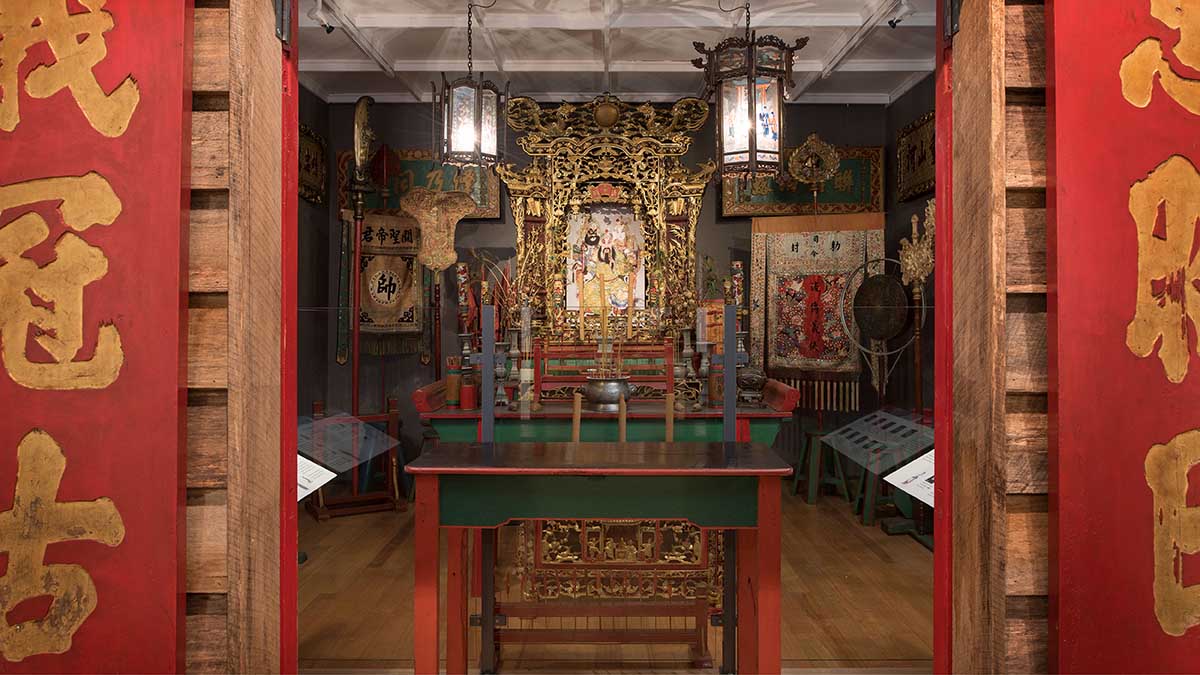
Image: View of the Guan Di Temple from temple's entrance doors. Photo: QVMAG.
This temple holds the contents of a number of Chinese temples from north-eastern Tasmanian mining towns.
As Tasmanian Chinese these temples gradually closed down, their contents were kept and eventually donated to the Museum in 1934 as both a display and as a place of worship for the local community.
The Guan Di Temple is both a place of worship and a unique collection of rare and fascinating objects. The collection includes decorated plaques, incense burners and other ceremonial items, and offers a window into Chinese religious practice in Tasmania during the 1880s.
Art Gallery at Royal Park, 2 Wellington Street
Long-term exhibition
Free entry
Please note: To support the safety of our visitors and the objects on display, burning of incense within the temple is only permitted during special events.
Virtual Tour - Guan Di Temple
Virtual Tour: Explore the Guan Di Temple
Take a virtual tour of the historic Guan Di Temple in the Art Gallery at Royal Park.
Guided Audio Tour: discover the temple like never before
Discover the history of the Guan Di Temple and objects within through a new guided audio tour with QVMAG Collections Officer, Jon Addison. Through this immersive guided storytelling experience, discover the stories and history behind this beloved community display. Listen online, or experience this tour within the temple through your own device and headphones.
Guan Di (关帝 / 關帝)
This temple’s principal deity is Guan Di (or Kuan Ti), the Taoist god of war and Buddhist protector. Originally known as Guan Yu, he was a historical figure who became a General during the Three Kingdoms period of Chinese history. Early in his career he met Zhang Fei (张飞 / 張 飛) and Liu Bei (刘备 / 劉備), with whom he swore an oath of brotherhood. After many great deeds highlighting his loyalty, bravery and integrity, he was killed in 219 CE, and was elevated to become a deity soon afterwards.
He represents loyalty, righteousness, justice and humility, as well as literature and learning. He is worshipped for his ability to cast out demons and prevent war.
Guan Di is a patron of brotherhoods and secret societies, and encourages loyalty between unrelated people.
An important temple
The Guan Di Temple at the QVMAG Art Gallery contains material from a number of temples from north eastern Tasmanian mining towns. As the Chinese population gradually declined, many smaller towns were abandoned.
As the temples closed, key items from each were brought together, eventually ending up in Weldborough. When the Weldborough temple closed in 1934, the custodian, Jee Harm (余文沾 / 餘文霑 /Yu Wen Zhan), gave the contents to the Queen Victoria Museum and Art Gallery.
All Tasmanian temples were built during the 1880s, when the population of Chinese in Tasmania was at its peak. The original temples were small wooden buildings with tin roofs. They always had a verandah at the front to act as a portico, and were aligned north-south.
The inscriptions on many of the items in this temple tell us that they were donated by individuals, surname lodges, lodges of the Hong Men (洪门 / 洪門) or district associations. The temple collection contains many highly significant items, some of which are rare even in China. Not all items are on display as many are extremely delicate and fragile.
You can explore the region where the original temples were located on a drive from Launceston to St Helens. Watch for the red ‘Trail of the Tin Dragon’ markers at Branxholm, Moorina and Pyengana, and visit the St Helens History room at St Helens.
The Chinese in North East Tasmania
Chinese people have a long history in Tasmania. From the 1860s, Chinese miners came to the north east of the state to search for gold. However, the success of tin mining in the north east attracted far more. By 1891, the Chinese population was almost 1000 – making it the largest non-European group in Tasmania.
Most were young men who came to make money and then return to China, but many stayed, married into the local population and became part of the community.
The Chinese population gradually reduced with the decline of alluvial mining. By 1921, 234 Chinese people remained in Tasmania. Most had left mining to run small businesses such as market gardens, laundries or general stores. There are descendants of these pioneers in Tasmania and other states.